


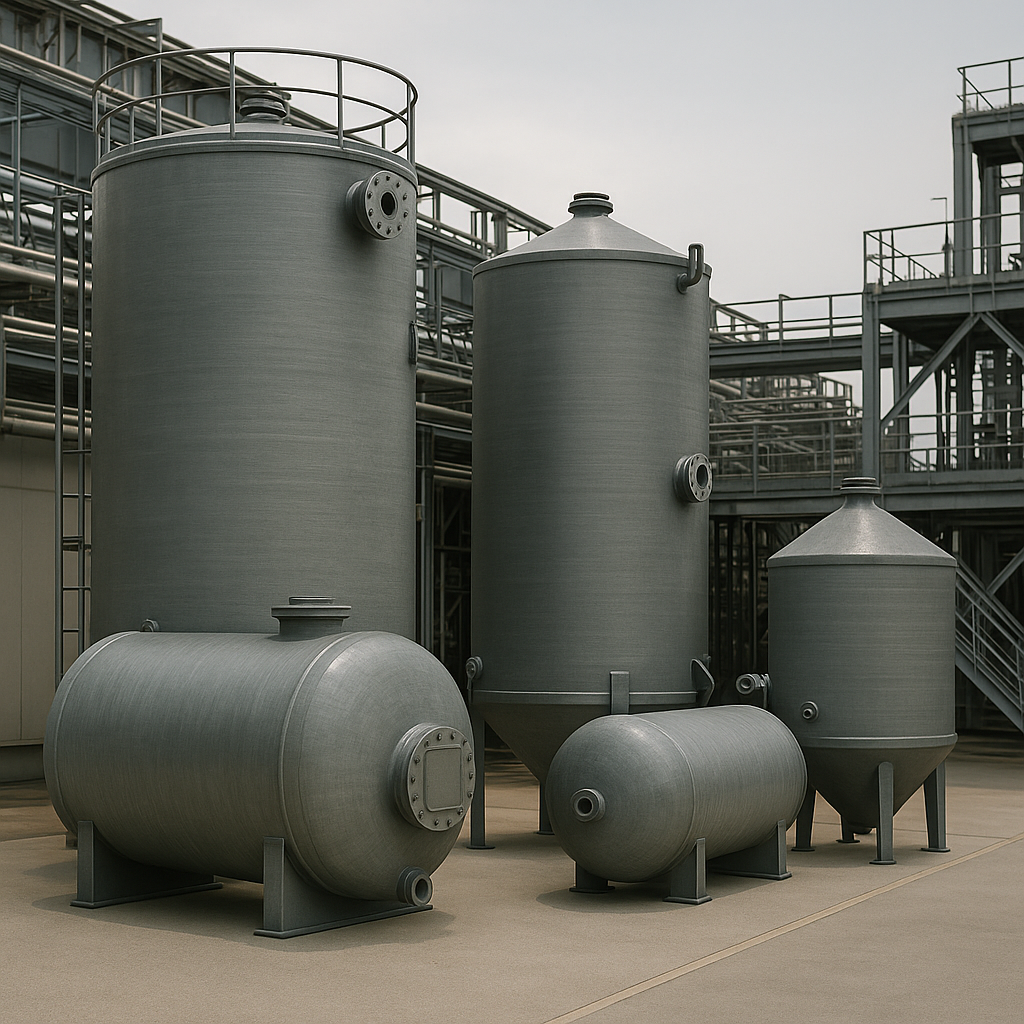
Corrosion-Proof Vessels for Safe, Long-Term Chemical Storage
Reconsky Fiber Glass Pvt. Ltd. offers premium FRP Chemical Storage Tanks engineered for superior durability, chemical resistance, and operational efficiency. Manufactured using advanced filament winding techniques with high-quality fiberglass and resin composites, our tanks ensure safe, reliable containment of aggressive chemicals, acids, alkalis, solvents, and process fluids across a wide range of industrial conditions.
What Are FRP Chemical Storage Tanks?
FRP (Fiberglass Reinforced Plastic) Chemical Storage Tanks are composite vessels fabricated by layering fiberglass reinforcements embedded in thermoset resins such as vinylester, polyester, bisphenol, or epoxy. These tanks are designed to withstand severe chemical attack and mechanical stresses while providing leak-proof, waterproof, and long-lasting storage.
Reconsky manufactures vertical, horizontal, single-wall, and bunded (double-wall) tanks, offering customized solutions for chemical, petrochemical, pharmaceutical, water treatment, and allied industries.
Key Features & Benefits
Exceptional Corrosion Resistance
Resistant to a wide range of acids, alkalis, salts, and organic solvents, ensuring long service life without degradation.
High Mechanical Strength
Filament wound construction delivers excellent tensile and compressive strength to withstand internal pressure and external loads.
Seamless & Leak-Proof Design
Monolithic construction ensures zero leakage, seepage, or contamination.
Thermal Insulation
Low thermal conductivity protects stored chemicals from temperature variations.
Low Maintenance & Long Life
UV resistant, weatherproof, and corrosion-free construction ensures years of maintenance-free operation.
Custom Sizes & Configurations
Capacities from a few hundred liters to several hundred kiloliters with customized tops, bottoms, and accessories.
Environmentally Safe
Designed for secure containment, minimizing environmental contamination risks.
Economical Life-Cycle Cost
Long service life with minimal repair or replacement ensures excellent ROI.
Technical Specifications
- Design Standards: BS 4994, ASME RTP-1, ASME Section X
- Material: FRP with Polyester, Vinylester, Bisphenol, or Epoxy Resin
- Construction Method: Filament Winding / Hand Layup
- Tank Types: Vertical, Horizontal, Single-Wall, Bunded (Double Wall)
- Capacity Range: 100 Liters to 500,000 Liters
- Temperature Range: -20°C to +80°C (resin dependent)
- Accessories: Ladders, agitators, gear boxes, level indicators
- Color Options: Standard and custom colors
Applications
- Chemical industry – acids, alkalis, solvents, and process chemicals
- Petrochemical and refining plants
- Pharmaceutical manufacturing and storage
- Water and wastewater treatment facilities
- Food and beverage ingredient storage
- Agriculture and fertilizer storage
- Power generation and desalination plants
Why Choose Reconsky FRP Chemical Storage Tanks?
Reconsky combines decades of FRP manufacturing expertise with strict quality control and international standards compliance. We provide customized tank solutions, competitive pricing, comprehensive documentation, and responsive after-sales support—ensuring safe, efficient, and long-lasting chemical storage for every application.
Frequently asked questions
An FRP chemical storage tank is a vessel manufactured from fiberglass reinforcement and corrosion-resistant resin systems, designed for long-term storage of aggressive chemicals such as acids, alkalis, salts, and process liquids. Unlike MS tanks, FRP tanks do not rust and do not require rubber lining or frequent repainting, significantly reducing maintenance and risk of corrosion-related failure. Compared to RCC tanks, FRP tanks are much lighter, leak-proof, and faster to install, avoiding cracking, seepage, and extensive civil work. They can be fabricated in vertical, horizontal, or custom configurations across a wide capacity range, making them ideal for chemical, pharma, ETP, and food industries, especially in Gujarat’s corrosive and coastal environments.
With appropriate resin selection such as isophthalic, bisphenol, vinyl ester, or epoxy, FRP chemical tanks can safely store a wide range of inorganic acids (including HCl, H2SO4, and HNO3 within recommended limits), caustic solutions, saline media, and many organic chemicals. The laminate structure is engineered to resist chemical permeation and mechanical loads, ensuring long service life under demanding operating conditions. Tanks are suitable for ambient and elevated temperatures and are UV-stabilised for outdoor installation, making them ideal for open tank farms and coastal locations. For specialised or mixed chemicals, engineering review ensures the correct resin and laminate design for safe storage.
FRP chemical storage tanks are available from small capacities of around 100 litres up to large industrial tanks of approximately 300,000 litres (300 KL). Configurations include vertical cylindrical tanks with flat or conical bottoms, horizontal tanks on saddles, and custom or rectangular designs for space-limited areas. Tanks are designed and manufactured in accordance with standards such as BS 4994, ASME RTP-1, ASME Section X, EN 13121, and relevant ISO/DIN codes. Accessories including manholes, nozzles, vents, level indicators, ladders, and safety railings are integrated to meet process and safety requirements.
FRP chemical tanks are corrosion-resistant by design, eliminating liner failures, under-film corrosion, and frequent maintenance associated with steel tanks. Their leak-proof construction reduces environmental risk, product loss, and unplanned shutdowns when handling hazardous chemicals. Smooth internal surfaces minimise residue build-up and simplify cleaning, reducing downtime during maintenance or product changeovers. With no repainting or major refurbishment required, operating costs are significantly lower over a 15–20+ year service life compared to MS or RCC tanks.
Reconsky begins each project with a detailed design brief covering chemical properties, concentration, temperature, specific gravity, capacity, installation location, wind and seismic data, and applicable design codes. Tanks are engineered for laminate thickness, nozzle reinforcement, support conditions, and safety factors in line with BS 4994, ASME, and related standards. Each tank undergoes inspection and hydrotesting, with drawings, calculations, and test certificates provided for audits and statutory compliance. Installation guidance includes foundation design, anchoring, lifting, site hydrotesting, and safe commissioning. For Gujarat’s chemical hubs such as Ankleshwar, Vapi, Dahej, and Hazira, local technical support ensures long-term reliability and easy future integration.