


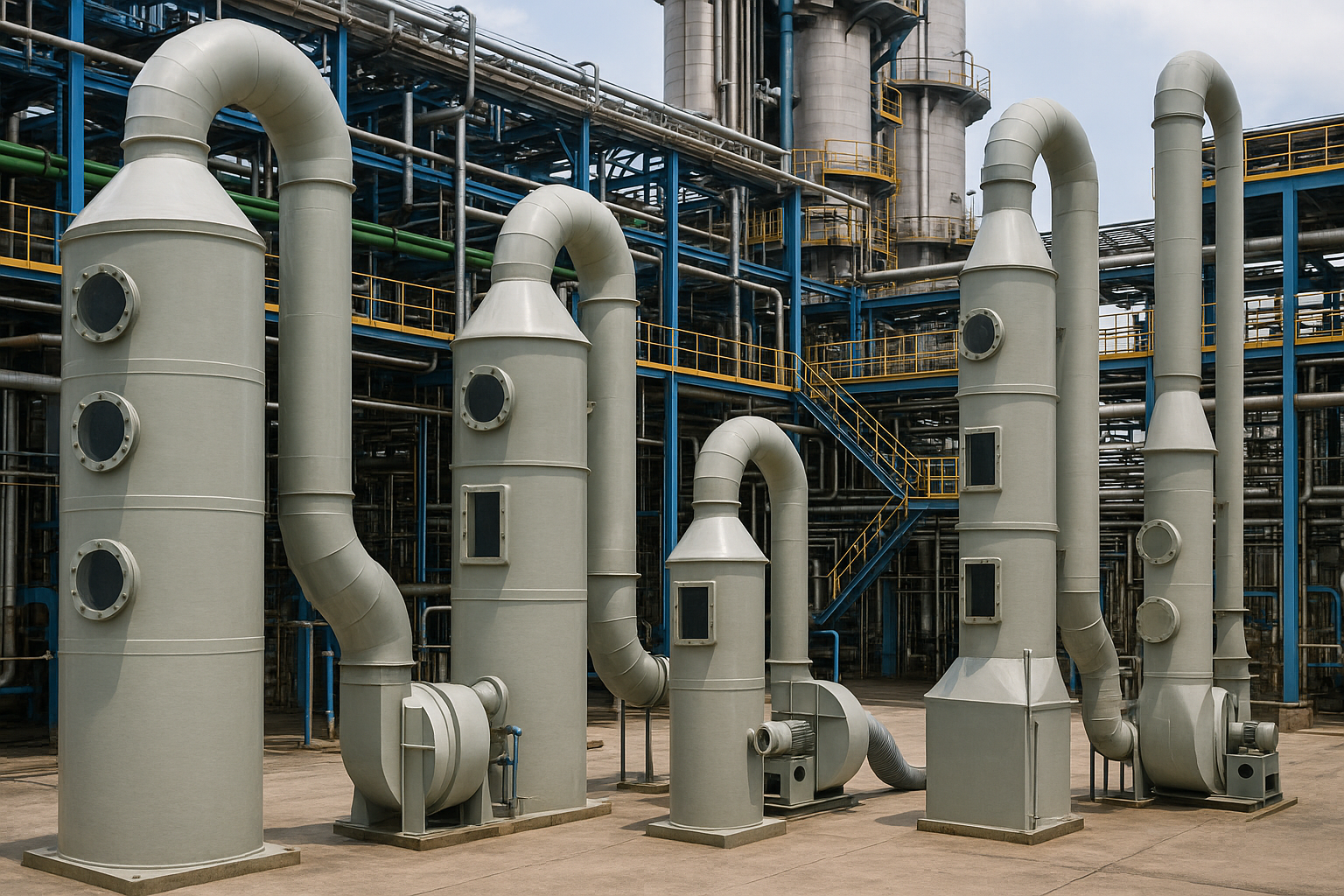
Advanced Air Pollution Control Systems Engineered for Industrial Efficiency
Reconsky Fiber Glass Pvt. Ltd. offers a cutting-edge range of PP FRP Scrubbers designed to effectively remove air pollutants and hazardous gases from industrial exhaust streams. Combining corrosion-resistant polypropylene with fiberglass reinforcement, our scrubbers provide durable, efficient, and adaptable solutions suited for diverse sectors including chemical processing, pharmaceuticals, metal finishing, and wastewater treatment.
Types of PP FRP Scrubbers
Dry Media Scrubbers
Employ solid adsorbents to trap pollutants from gas streams. Particularly effective in capturing certain organic and inorganic vapors in facility exhausts.
Wet Media Scrubbers
Utilize water or chemical liquid sprays to absorb and neutralize airborne contaminants. Ideal for controlling gaseous pollutants and particulates.
Biological Scrubbers
Incorporate bio-media containing microorganisms that biodegrade odorous and hazardous substances, widely used for odor control and pollution mitigation.
What is a PP FRP Wet Scrubber?
A PP FRP Wet Scrubber is a corrosion-resistant air pollution control device constructed of polypropylene reinforced with fiberglass. It maximizes contact between contaminated air and scrubbing fluid (water or chemicals), effectively removing particulate matter, acid gases, and volatile organic compounds before air release.
How Reconsky Wet Scrubber Systems Work
Entry of Polluted Air
Exhaust air, laden with particulates, chemical vapors, and acid gases, are ducted into the scrubber system for treatment.

Contact with Scrubbing Media
Depending on scrubber type, the air either passes through dry adsorbents, gets sprayed with liquid scrubbing medium, or interacts with bio-media where microbes neutralize pollutants.

Separation of Clean Air and Waste
Mist eliminators extract entrained droplets and particles, ensuring only purified air is emitted.

Spent Media Management
Spent liquid or media are collected and treated per environmental norms.

Pollutant Removal
. Wet scrubbers dissolve and absorb pollutants into the liquid phase.
. Dry scrubbers adsorb contaminants on solid media.
. Biological scrubbers metabolize noxious gases.
System Features
- Robust chemical- and corrosion-proof construction using high-grade PP FRP material.
- Variety of scrubber types (Dry, Wet, Biological) customized for specific industrial needs.
- High pollutant removal efficiency, often exceeding 90-99%.
- Low operational and maintenance costs.
- Modular and flexible designs for easy integration.
- Compliance with ISO 9001:2015 and ISO 14001:2015 quality and environmental standards.
Industrial Applications
- Chemical and pharmaceutical manufacturing plants
- Oil, gas, and petrochemical industries
- Food and beverage processing factories
- Metal finishing and electroplating units
- Cement, power generation, and heavy industries
- Wastewater treatment and odor control facilities
Benefits of Choosing Reconsky PP FRP Scrubbers
- Decade-long proven industrial experience and technical expertise.
- Customized designs tailored to your facility’s emissions control requirements.
- Comprehensive technical support with turnkey installation and after-sales service.
- Certified quality, environmental responsibility, and regulatory compliance.
- Competitive pricing and reliable product longevity.
For consultation, custom design, and quotations on PP FRP scrubber systems, contact Reconsky Fiber Glass Pvt. Ltd.
Invest in Reconsky PP FRP Scrubbers—engineered for industrial efficiency, environmental compliance, and long-term operational excellence


Frequently asked questions
A PP FRP scrubber is an air pollution control system made from polypropylene (PP) lined or combined with fiberglass reinforced plastic (FRP), designed to remove acid fumes, chemical vapours, and particulate-laden gases from industrial exhaust streams. Unlike mild steel (MS) or PVC scrubbers, PP FRP scrubbers offer excellent corrosion resistance against a very wide pH range, including strong acids and alkalis, which greatly extends system life and reduces unexpected breakdowns. The FRP structural layer adds high mechanical strength with a low weight, making the system easier to install on RCC terraces or steel structures without heavy foundations.
In a PP FRP wet scrubber, contaminated flue gas is ducted into the scrubber body where it is forced through a packed bed or spray zone, and intensively contacted with a scrubbing liquid such as water, caustic, or acid solution depending on the target pollutants. Soluble gases like HCl, SO₂, NH₃, and many VOCs transfer from the gas phase into the liquid film on the packing surface, where they are neutralised or absorbed. Mist eliminators at the outlet capture entrained droplets to ensure that only cleaned gas leaves the stack. By optimising liquid-to-gas ratio (L/G) and contact time, Reconsky systems routinely achieve 90–99% removal efficiency.
To select the correct PP FRP scrubber, you need to define key design parameters such as gas flow rate (m³/hr), inlet pollutant concentration, target outlet emission limits, gas temperature, and available plot / height. Reconsky’s design team uses this data to choose the appropriate scrubber type (dry, wet, or biological), packed height, tower diameter, recirculation flow, and pump / blower sizing. The final proposal usually includes performance guarantees, utility consumption estimates, and footprint so that project, maintenance, and EHS teams can evaluate ROI and compliance together.
Well-designed PP FRP scrubbers are low-maintenance because the construction is inherently corrosion-proof and mechanically robust, avoiding frequent patching or repainting. Routine maintenance primarily focuses on checking pump performance, nozzle condition, liquid circulation lines, and ensuring packing and demisters are not clogged. Operators typically monitor pressure drop across the packed bed and pH of the recirculating liquor. Because Reconsky uses high-grade PP and FRP, the risk of structural failure is extremely low, translating into attractive lifecycle costs for 24×7 operations.
Reconsky PP FRP scrubbers are engineered to meet or exceed national and state-level emission standards, helping industrial units demonstrate continuous compliance during stack monitoring and audits. By capturing and neutralising harmful gases at source, the systems significantly reduce workplace exposure, corrosion of nearby structures, and odour complaints. PP FRP designs also reduce material wastage and frequency of replacement. Combined with proper effluent handling, these systems support a modern “responsible manufacturing” narrative useful for ESG reporting and sustainability audits.